


Services
Bioinformatic
Bio-Fab's bioinformatics services are designed to meet our clients' growing demand for a comprehensive analysis service, from data generation to processing and transformation.
Each specific analysis is designed to meet the client's needs, who, together with our experts, will participate in the processing of the scientific data produced in the Bio-Fab laboratories.
Bio-Fab's bioinformatics services are designed to offer both pre- and post-analysis consulting, both on data obtained from our sequencers and on data delivered directly by the client.
The analyses, in each of the services and with maximum flexibility, can be basic, advanced, and/or customized.
Some Bio-Fab bioinformatics services include
- Metagenomic Analysis (Metabarcoding)
- Whole Genome Sequencing; Plasmid Finder; Virulence Finder)
- Differential Expression of Transcripts (mRNA Sequencing)
- Differential Expression of MiRNAs
For information, contact us by email at:
info@biofabresearch.it
ricerca-sviluppo@biofabresearch.it

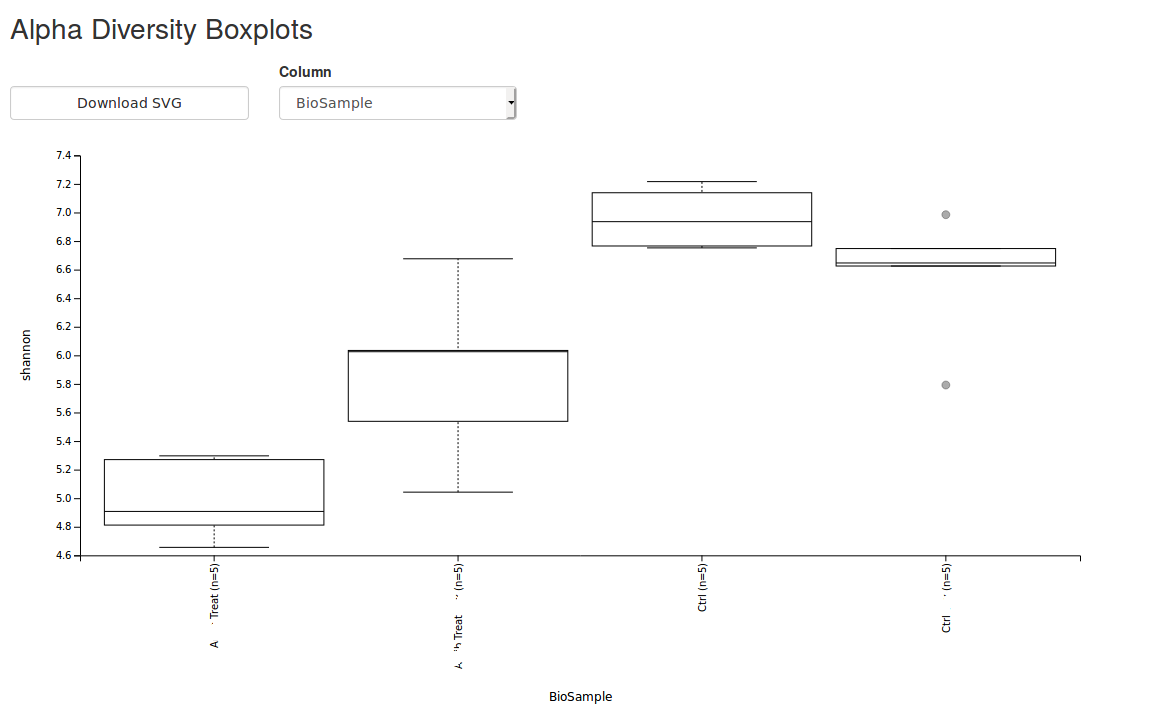 Click to enlarge
Alpha Diversity Plot
 Click to enlarge
Alpha Rarefaction
 Click to enlarge
Volcano Plot
Bio-Fab Services
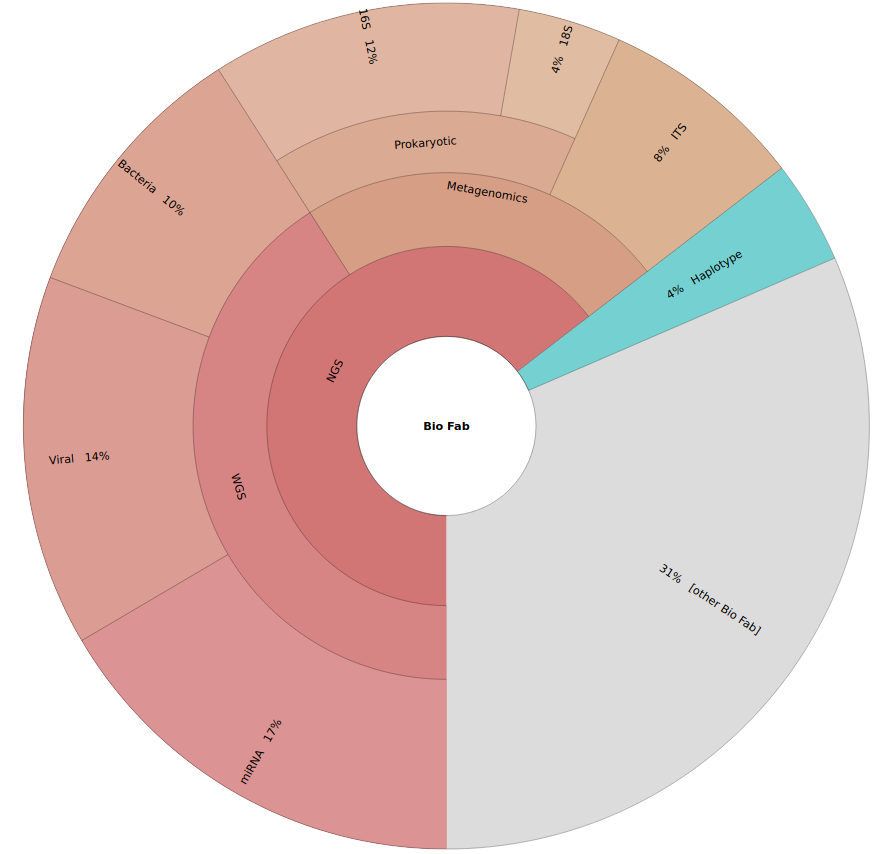 Click to enlarge
Word Clouds
 Click to enlarge
COVERAGE: What does it mean in the context of NGS?
The term “Coverage” is often used, but it sometimes causes confusion. This is because, in addition to the common definition, there are alternative descriptions, various types (including various forms of calculation), and confusion with another term: sequencing depth.
- Redundancy coverage: The number of reads that align or "cover" a reference. It describes how often, on average, each base of a reference sequence is covered by aligned reads. This is important information because multiple observations of a base at a given position are needed to obtain a reliable call (e.g., in variant analyses). Therefore, redundancy coverage is also used as a measure of the statistical significance of sequencing data. Depending on the reference (whole genome or a locus), there are different ways to calculate coverage.
- Coverage in terms of percentage coverage: of a reference by the reads aligned to it. For example, if 90% of a reference is covered by reads (and 10% are not), we say we have 90% coverage.
- Sequencing depth: Total number of fragments sequenced (raw reads) or produced by the sequencing platform (usually expressed in millions of reads).
Among these terms, the only one that can be estimated a priori is sequencing depth. Estimating the other two forms of coverage depends on the alignment of the reads to the reference as well as on quality parameters used to filter the raw reads during the initial steps of the bioinformatics analysis.
All three meanings of the term coverage are estimated using the same formula, which can be rearranged for each terminology.
What is good coverage for an NGS project?
There are general or specific guidelines that describe the optimal coverage for a sequencing project. It depends heavily on the type of experiment, species, input material, sequencing platform, and other factors. However, we recommend contacting our sequencing service about this question before ordering a project so we can leverage their existing expertise.
Are there regions in the genome that aren't covered by DNA sequencing?
If the genome were a road and you created a map of the footprints of passersby on that road, the map would certainly have some blank areas. In other words, some genomic regions can't be covered very well by DNA sequencing with NGS technology due to repetitive sequences (e.g., tandem repeats), which are abundant in a wide range of species.
About 50% of the human genome is composed of repeats. Repeats pose a challenge for sequence alignment and assembly programs, especially if they generate short, very similar reads. It can be compared to a large jigsaw puzzle, where some pieces fit together in different places. Repetitions therefore create ambiguities in alignment and assembly, which, in turn, can lead to bias and errors in the interpretation of results.
GC% also affects overall coverage. The four bases (ACTG) are normally not evenly distributed across a genome. DNA regions with high and low GC% are difficult to amplify due to their higher stability compared to a DNA region with a mixed base content. In these cases, DNA polymerase is prone to producing artifacts. These effects disrupt the amplification steps required in most protocols. As a result, fragments from regions with high/low GC% are underrepresented, resulting in poor and unbalanced coverage.
Some current projects seek to improve the sequencing of such regions by minimizing artifacts produced by PCR (amplification in the case of platforms like Illumina) or by omitting the amplification step (for example, with MinION).
Finally, fragmentation in shotgun methods affects coverage because, as reported in the literature, DNA fragmentation is a largely non-random process, especially for mechanical shearing methods. This leads to uneven coverage of various genomic regions and can result in regions with zero or lower coverage than estimated/desired.